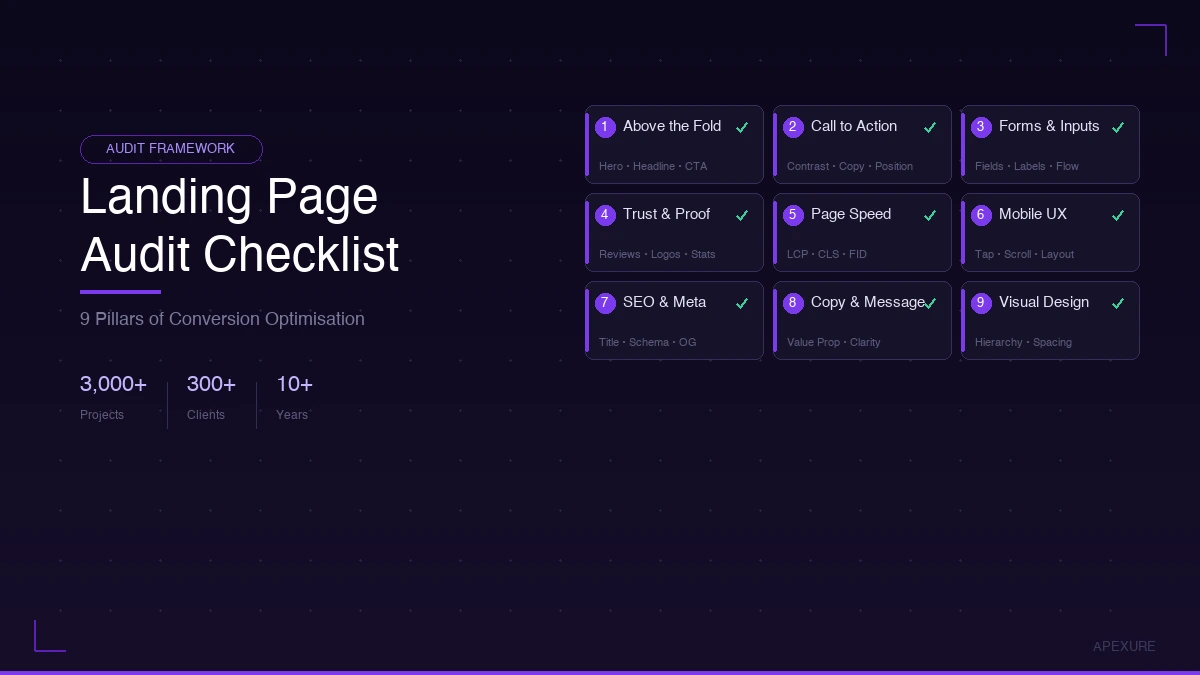
Have you tried everything you can think of, yet your landing page still is not converting? You are not alone. After 10+ years of building and optimising landing pages for 300+ clients, from startups to established enterprises, we have seen virtually every conversion problem there is. The good news is that most of them are fixable once you identify the root cause. In this guide, we break down the 14 most common reasons your landing page is not converting and provide actionable solutions for each. These are not hypothetical tips. They are drawn from real projects across 3,000+ landing page builds. Whether you are running Google Ads, Facebook campaigns, or organic traffic, the principles here apply. Let us start diagnosing.
1. Your landing page is actually your home page
One of the most common mistakes we see when auditing new client landing pages is using the homepage as the landing page for paid campaigns. A homepage is designed to introduce your brand and provide multiple navigation paths. A landing page is designed to do one thing: convert. When you send PPC traffic to your homepage, you are asking visitors to figure out what to do next. Multiple nav links, footer links, blog feeds, and social icons all compete for attention, and they win, pulling visitors away from your intended conversion goal.
The fix: understand the core differences
Homepage Approach ❌
- Multiple navigation links and menus
- Broad messaging about company and services
- Several CTAs competing for attention
- Blog feeds, news, social media links
- Footer with sitemap-style navigation
- Designed for browsing and exploration
Dedicated Landing Page ✅
- No navigation, zero exit points
- Focused messaging matching the ad
- Single, clear CTA repeated throughout
- Only content that supports the conversion
- Minimal footer with privacy links only
- Designed for a single conversion action
The data backs this up consistently. In our experience building 3,000+ landing pages, removing navigation alone typically improves conversion rates by 20-30%. The visitor clicked your ad for a specific reason, your landing page should deliver on that promise and nothing else.
Suggested Read: Landing Page vs Home Page: Key Differences Explained
2. Incorrect audience targeting
No amount of landing page optimisation can fix a fundamental targeting problem. If the wrong people are clicking your ads, your page will never convert because the offer simply does not match their intent. We frequently see this with broad-match keywords in Google Ads campaigns or poorly defined Facebook audiences. The traffic looks healthy in analytics, but conversion rates hover near zero.
The fix: strengthen your buyer personas
Before redesigning your landing page, audit your traffic sources. Check your Google Ads search terms report and Facebook audience insights. Are the people arriving actually your ideal customers? Build detailed buyer personas that include:
- Demographics (age, location, job title)
- Pain points and challenges they face
- Where they are in the buying journey
- What language and terms they use
- What objections they will raise Then create separate landing pages for each persona. A single landing page trying to serve everyone ends up serving no one effectively.
3. Ad-to-Page message mismatch
Imagine clicking an ad that promises “50% Off Your First Month” only to land on a page that talks about the product’s features with no mention of the discount. That disconnect instantly erodes trust. The visitor feels misled and bounces. This message mismatch, between what the ad promises and what the landing page delivers, is one of the most destructive conversion killers. It also damages your Google Ads Quality Score, which increases your cost per click.
The fix: maintain perfect ad scent
“Ad scent” is the consistency between your advertisement and landing page. Every element should reinforce the promise made in the ad:
Ad Scent Checklist
- Headline matches the ad headline (or closely mirrors it)
- Same offer, discount, or value proposition
- Consistent visual style, colours, and imagery
- Same tone of voice and language
- CTA text fits the ad's promise
- Landing page delivers what the ad "sold"
Create separate landing pages for different ad groups and campaigns. Yes, this means more pages to manage, but the conversion lift is almost always worth the effort. Our paid search landing page best practices guide covers this in more detail.
4. Your landing page ignores your brand voice
Visitors will lose interest immediately if your landing page does not feel like it belongs to your brand. The foundation of credibility and trust is familiarity. Your communication style, the words you choose, your tone, and your visual identity all work together to create a distinct impression. If you compromise your brand voice by using generic templates, stock photos that feel out of place, or copy that sounds like it was written by someone who has never used your product, visitors notice. Trust drops, and so do conversions.
The fix: design in line with your brand
Make sure every landing page shows your brand consistently:
- Use your brand colours, fonts, and design patterns consistently across ads and landing pages
- If your brand is conversational, keep the landing page conversational. If it is formal and authoritative, maintain that tone
- Use original photography or illustrations that feel authentic to your brand. Avoid generic stock photos that visitors have seen on a dozen other sites
- Your unique value proposition should come through clearly, not buried under feature lists This consistency builds trust from the first impression. When a visitor clicks an ad and arrives on a page that looks and feels like the same brand, cognitive load drops and willingness to convert rises.
Related: Landing Page Design Inspiration Ideas Proven to Convert
5. Too many elements create choice paralysis
You want to give visitors every piece of information they might need. So you add feature lists, comparison tables, pricing tiers, testimonials, videos, a chatbot, pop-ups, and multiple CTAs. The result? Cognitive overload. Hick’s Law tells us that the time required to make a decision increases with the number of options available. Every additional element, link, or CTA on your landing page is another decision point that slows the visitor down, and in many cases, causes them to leave entirely.
The fix: ruthless simplification
Strip your landing page down to the essentials:
- One primary CTA, repeated at the top, middle, and bottom of the page
- Remove all navigation links, the visitor should only be able to convert or leave
- Use white space deliberately to guide the eye toward the CTA
- Limit form fields to only what you absolutely need (more on this below) When we audit a new client’s landing pages, the first thing we check is the attention ratio, the number of links on the page versus the number of conversion goals. The ideal ratio is 1:1. If yours is 15:1 or higher, that is likely a significant contributor to your landing page not converting.
6. Your form asks too many questions
One of the main reasons visitors abandon landing pages right at the point of conversion is that the form demands too much information. First name, last name, email, phone, company name, company size, industry, job title, budget range, by the time they reach the end. They have decided it is not worth the effort.
The fix: minimise form friction
| Form Approach | Fields | Typical Impact on Conversion |
|---|---|---|
| Email only | 1 | Highest conversion rate |
| Name + Email | 2 | Strong conversion, some personalisation |
| Name + Email + Phone | 3 | Good for sales-qualified leads |
| 4-6 fields | 4-6 | Moderate drop, higher lead quality |
| 7+ fields | 7+ | Significant conversion drop |
| Multi-step form | Variable | Best of both: high completion + quality |
The best approach depends on your business model. If you need detailed information, consider using a multi-step form that asks one or two questions per step. This reduces perceived effort and creates a sense of commitment through progressive disclosure. In our landing page for EcoGen America, a multi-step form approach pointed toward an 8.36% conversion rate in the competitive solar industry.
Related: 23 Landing Page Form Design Best Practices With Examples
7. Your landing page is slow
Page speed is not a luxury. It is a conversion requirement. Research consistently shows that each additional second of load time reduces conversions by approximately 7%. In 2026, with Core Web Vitals now a confirmed ranking factor and user expectations higher than ever, a slow page is essentially a broken page.
The fix: optimise for speed
- Compress and resize images, use WebP format and lazy loading
- Minify CSS, JavaScript, and HTML files
- Use a CDN (Content Delivery Network) to serve assets from the closest server
- Eliminate render-blocking resources that delay the visible content
- Choose a performance-optimised hosting provider or landing page platform
- Audit with Google PageSpeed Insights and aim for scores above 90 Platforms like Unbounce (which we use extensively as an official agency partner) have built-in speed optimisations that eliminate many of these issues. For custom-built pages, implementing these fixes can dramatically improve both conversion rates and Quality Scores.
Related: How To Increase Page Speed Of Your Websites & Landing Pages
8. Boring or unclear Call-to-Action
Generic CTAs like “Submit,” “Buy Now,” or “Sign Up” are conversion killers. They tell the visitor what to do but not what they will get. There is no value proposition in the button itself, and no emotional trigger to compel the click.
The fix: build CTAs that communicate value
Your CTA should answer the question: “What happens when I click this?” Here is what separates weak CTAs from strong ones:
Weak CTAs ❌
- "Submit"
- "Buy Now"
- "Sign Up"
- "Click Here"
- "Learn More"
- "Download"
Strong CTAs ✅
- "Get My Free Quote"
- "Start Saving Today"
- "Claim Your 50% Discount"
- "Book My Free Consultation"
- "See How It Works"
- "Get the Free Guide"
Beyond the copy, CTA button design matters:
- The button should visually pop against the page background
- Large enough to be easily tappable on mobile, but not so large it feels aggressive
- Above the fold, and repeated after every major content section
- Add a micro-copy line below the button (e.g., “No credit card required” or “Takes 30 seconds”)
- Time-sensitive language like “today” or “limited spots” when appropriate
Suggested Read: 15 Landing Page Call to Action Button Tips That Convert
9. No sense of urgency
With thousands of ads competing for attention every day, visitors have no strong reason to act right now unless you give them one. Without urgency, they mentally bookmark your page with good intentions, and never return.
The fix: use scarcity and time pressure ethically
Effective urgency tactics include:
- Countdown timers for limited-time offers or upcoming deadlines
- Limited availability indicators (“Only 3 spots remaining this month”)
- Seasonal or event-based framing (“Pre-conference pricing ends Friday”)
- Social proof urgency (“47 people booked this week”)
- Expiring bonuses (“Sign up before March 31st and get a free audit”)
The key is authenticity. When we design landing pages at Apexure, we tie urgency to real business constraints, limited consultation slots, seasonal pricing, or genuine deadline-driven offers.
10. Missing or weak social proof
Visitors are inherently sceptical, especially when they encounter a brand for the first time. Without evidence that other people have trusted your business and been satisfied, the risk of converting feels too high. Social proof is not optional. It is the single most effective trust-building element on a landing page. In fact, across our client projects, adding well-placed social proof consistently produces the highest conversion lifts in A/B tests.
The fix: layer multiple forms of social proof
Place social proof deliberately:
- Client logos or star ratings
- Testimonials addressing common objections
- Case study results with specific metrics
- Trust badges, security seals, or guarantee statements
Related: Ways To Increase Landing Page Social Proof For More Conversions
Real results: how social proof and CRO fixes drive conversions
The fixes above are not theoretical. Here are results from real client projects where we applied these principles.
Case Study: Flare.io, 65% Increase in Demo Conversions
Flare.io, a cybersecurity SaaS company, had a "Book a Demo" page that was underperforming. The page was long, cluttered with technical details, and the CTA was buried. We simplified the page, strengthened the headline, added targeted social proof, and moved the CTA above the fold.
Case Study: Radicle Science, 51.78% Conversion Rate
Radicle Science needed a clinical trial enrollment landing page that could reach 10,000 participants through social media marketing. We designed a landing page focused on clear messaging, strong social proof, and a frictionless form. The page was built with a single CTA and every section reinforced the value of participating.
Case Study: IMD Business School, 63% Conversion Lift
IMD's MBA program landing page was converting at 3.91%. After conducting heatmap analysis, we discovered that key trust elements (video testimonials and "About Us" content) were placed too low on the page. By restructuring the layout, improving content hierarchy, and running A/B tests on element placement, we increased the conversion rate to 6.38%.
What our clients say about working with us
"Waseem and his team bring a truly unique creativity, energy, and commitment to all of the work they do. The results that we've seen from the collaboration are outstanding, from the tremendous improvements in our own page speed and marketing performance to the satisfaction of the clients who work with them on PPC."
"They're collaborative, and it'll feel like they're part of your own team. From a design quality perspective. It's very impressive. They had a very strong process, wherein they were able to integrate the right resources at the right time."
11. Your offer is not strong enough
Sometimes the landing page itself is fine, the design is clean, the copy is clear, and the CTA is prominent. But nobody converts because the offer is simply not worth the visitor’s time or information. Generic offers like “Sign up for our newsletter” or “Contact us” do not communicate enough value to motivate action. Visitors ask themselves: “What do I get in return?” If the answer is unclear, they leave.
The fix: make the offer irresistible
Change your offer by focusing on immediate, tangible value:
- Free tools or calculators that solve a specific problem
- Industry-specific guides or reports with original data
- Free consultations or audits with clear scope and deliverables
- Demo access that lets visitors experience the product before committing
- Exclusive content (webinars, case studies, templates) gated behind the form The key question to ask is: “Would I exchange my email and 5 minutes of my time for this?” If the answer is no, strengthen the offer before optimising the page.
Related: What Is Landing Page Optimization and How to Get Started?
12. All words and no visual balance
A landing page filled wall-to-wall with text is a page that most visitors will never read. Research consistently shows that online users scan rather than read. If your landing page looks like a research paper, you have already lost most of your audience above the fold.
The fix: create a visual hierarchy
Balance text with visual elements that support your message:
- Hero images or videos that demonstrate your product or outcome
- Icons and illustrations to break up text and accent benefits
- Screenshots or product mockups that show what the visitor gets
- Short bullet points instead of paragraphs for key benefits
- Strategic use of white space to let content breathe The ideal landing page follows a scannable pattern. Key components of a landing page should be structured so visitors can grasp the core message in under 5 seconds, then dive deeper if interested.
13. Disoriented purpose: no clear information hierarchy
When everything on the landing page competes for attention, nothing stands out. Visitors should be able to understand what you offer, why it matters, and what to do next within seconds of arriving. If your headline is vague, your benefits are buried below the fold, and your CTA requires scrolling past three paragraphs of text. You have a clarity problem.
The fix: structure for immediate comprehension
Follow the landing page conversion rate optimisation tips principle of “clarity over cleverness.” Your above-the-fold area should answer three questions instantly:
- What is this? (Headline)
- Why should I care? (Benefits/value proposition)
- What do I do next? (CTA) If a visitor has to scroll to find the answer to any of these questions, restructure your page.
14. Your landing page lacks a unique selling proposition
Visitors are comparing you to competitors in real-time. If your landing page looks and sounds like every other option in your industry, there is no reason to choose you. You need a clear USP that differentiates your offer from the alternatives.
The fix: build connection through storytelling and differentiation
Effective USP strategies include:
- What can you do that competitors cannot? Quantify it. “Average response time: 4 minutes” is more strong than “fast customer service”
- Tap into the transformation your product delivers, not just its features
- Show the visitor you understand their specific challenge and have a proven solution
- Position your brand as an authority with social proof, client logos, and quantified results At Apexure, we use storytelling techniques to captivate visitors with landing pages because data alone does not convert, emotional connection does.
How to prioritise your fixes: the EPIC framework
With 14 potential issues to address, where do you start? This is where a structured testing framework becomes essential. At Apexure, we use our proprietary EPIC CRO Framework to prioritise which fixes to implement and test first:
Using EPIC, here is how we would typically prioritise the 14 fixes covered in this guide:
| Priority | Fix | EPIC Score | Why |
|---|---|---|---|
| 1 | Ad-to-page message match | High | Biggest impact, lowest cost, often just copy changes |
| 2 | Remove navigation / simplify | High | Quick implementation, immediate measurable results |
| 3 | Add social proof | High | High impact, moderate effort to collect and place |
| 4 | Fix CTA copy and placement | High | Small change, big potential uplift |
| 5 | Reduce form fields | Medium-High | Easy to test, clear metric to measure |
| 6 | Improve page speed | Medium-High | Technical effort, but compounds over time |
| 7 | Strengthen the offer | Medium | Requires strategy work but high potential payoff |
| 8 | Fix audience targeting | Medium | Needs upstream changes in ad platforms |
For more on how to implement a systematic CRO process, read our complete Conversion Rate Optimisation Guide.
Watch: how to monitor and optimise landing pages for conversion
The diagnostic checklist: why your landing page is not converting
Before you start making changes, run through this diagnostic checklist to identify which of the 14 issues are affecting your page:
Landing Page Conversion Diagnostic
- Message match: Does your headline match your ad copy?
- Single focus: Is there only one CTA on the page?
- No navigation: Have you removed all navigation links?
- Page speed: Does the page load in under 3 seconds?
- Mobile-friendly: Does the page work perfectly on mobile?
- Social proof: Are testimonials, logos, or ratings visible above the fold?
- Form friction: Does the form ask only for essential information?
- CTA clarity: Does the CTA button communicate value, not just an action?
- Brand consistency: Does the page match your brand's visual identity and tone?
- Offer value: Would you personally exchange your info for this offer?
- Visual balance: Is the page scannable with a mix of text, images, and white space?
- Urgency: Is there a genuine reason to act now?
- USP: Can a visitor understand what makes you different in 5 seconds?
- Audience targeting: Is your traffic source sending qualified visitors?
If you answered “no” to more than three of these questions. You have identified your conversion bottlenecks. Start with the fixes that score highest on the EPIC framework.
See our work in action
EcoGen America, Solar Lead Generation
A multi-step landing page designed for residential solar panel inquiries. Clear messaging, trust-building social proof, and a simplified form pointed toward an 8.36% conversion rate in a competitive industry.
DOOR3, B2B Lead Generation
A conversion-focused landing page that changed DOOR3's sales pipeline. Strategic keyword targeting, strong copy, and CRO-driven design reduced cost per lead from $2,300 to $550, a 76% decrease.
Continuous optimisation: why fixing once is not enough
Landing page optimisation is not a one-time project. It is an ongoing discipline. Even after implementing all 14 fixes in this guide, the market shifts, competitors evolve, and user behaviour changes. The pages that convert best are the ones that are continuously tested and refined. At Apexure, we follow a structured 13-step CRO process that includes:
- Data collection, Setting up heatmaps (Hotjar, Crazy Egg) and analytics
- Behaviour analysis, Reviewing session recordings and scroll maps
- Hypothesis generation, Building a prioritised list of test ideas using the EPIC framework
- A/B testing, Running controlled experiments against the current champion
- Iteration, Implementing winners and generating new hypotheses This cycle repeats continuously. Each test feeds the next. The gains compound over time because each test teaches us something about the audience, regardless of whether the test wins or loses.
Related: Landing Page A/B Testing Framework to Maximize Conversions
Frequently asked questions
Why is my landing page getting traffic but no conversions?
The most common cause is a mismatch between your ad messaging and landing page content. Visitors click expecting one thing and find another. Other frequent causes include too many distractions (navigation links, multiple CTAs), a form that asks for too much information, and missing social proof. Start by checking your ad-to-page message match and making sure you have a single, clear call-to-action.
What is a good landing page conversion rate?
Average landing page conversion rates vary by industry, typically ranging from 2-5%. However, top-performing landing pages regularly achieve 10-25% or higher. In our experience building 3,000+ landing pages, we have achieved conversion rates as high as 51.78% (Radicle Science) and 27.89% (Board Agenda). The right conversion rate target depends on your industry, traffic source, and offer type. Focus on continuous improvement rather than hitting a specific benchmark.
How many CTAs should a landing page have?
A landing page should have one conversion goal repeated multiple times throughout the page. This means the same CTA button (e.g., "Get My Free Quote") placed at the top, middle, and bottom of the page. Avoid having multiple different CTAs competing for attention. This creates choice paralysis and reduces conversion rates. The ideal attention ratio is 1:1 (one link to one conversion goal).
How long should a landing page be?
There is no universal answer. Short pages work best for simple, low-commitment offers (like email sign-ups), while longer pages are necessary for high-ticket items or complex products that require more education and trust-building. The key is not length but relevance, every section should serve the conversion goal. Remove anything that does not directly point toward the visitor's decision to convert. Our landing page length guide covers this in more detail.
Should I use video on my landing page?
Video can significantly boost conversions, especially for products or services that benefit from demonstration. Product demos, customer testimonials, and explainer videos tend to perform well. However, video should complement your page, not replace the core content. Make sure the video does not auto-play with sound (this annoys visitors), keep it under 2 minutes, and include a transcript or text alternative for accessibility. Place it deliberately, near the CTA or as supporting content above the fold.
How do I test which changes actually improve conversions?
Use A/B testing to isolate and measure the impact of individual changes. Test one variable at a time (headline, CTA, form length, social proof placement) to identify what moves the needle. Prioritise tests using a structured framework like the EPIC CRO Framework to maximise learning from each test. Make sure you reach statistical significance (typically 95% confidence level) before declaring a winner, and never end tests early based on preliminary results.
What tools should I use to diagnose landing page conversion problems?
Start with Google Analytics (GA4) for traffic and conversion data. Add a heatmap tool like Hotjar or Crazy Egg to visualise where visitors click, scroll, and drop off. Use Google PageSpeed Insights for speed analysis. For A/B testing, tools like VWO, Unbounce (which includes built-in A/B testing), or Google Optimize alternatives work well. Session recording tools are invaluable for watching real visitor behaviour and identifying friction points. Our landing page optimization tools guide covers the best options in detail.
Should I hire a CRO agency or do it myself?
If your team has the time, tools, and expertise to run structured A/B tests. You can start with DIY optimisation using the fixes in this guide. However, if you are spending significant budget on PPC and your landing pages are underperforming, the ROI of working with a specialised CRO agency like Apexure typically pays for itself quickly. We bring 10+ years of data from 3,000+ projects, patterns and insights that would take years to build internally. Read our guide on hiring a CRO consultant for more on when it makes sense to bring in expert help.
Stop Losing Conversions. Get Expert Help.
After 10+ years and 3,000+ landing page projects, we have seen every conversion problem there is, and we know how to fix them. Whether you need a full landing page redesign, a CRO audit, or ongoing A/B testing, our team is ready to help.
With 200+ five-star reviews, we deliver results, not just designs.
Get a Free ConsultationRelated articles
- Landing Page Optimization Best Practices: Examples + Checklist
- 28 Landing Page Mistakes That Make You Lose Revenue
- How To Monitor Landing Pages For Optimized Conversions
- Landing Page Testing Basics For Faster Optimization
- How to Write Landing Page Copy That Gets You More Leads
- The Complete Guide to High Converting Landing Pages
- How To Improve Landing Page UX for Better Conversion
- CRO and UX: The Ultimate Duo to Maximize Conversions
The 50-point landing page checklist
Everything we check before a page goes live: copy, layout, forms, trust, speed and tracking. One PDF, sent by email.
Need a page built instead? Get a fixed quote.

Waseem founded Apexure in 2015 and has led its work on 3,000+ pages for 300+ clients since. He writes about what the team sees after the click, which is pages, forms, tracking and the systems behind them.